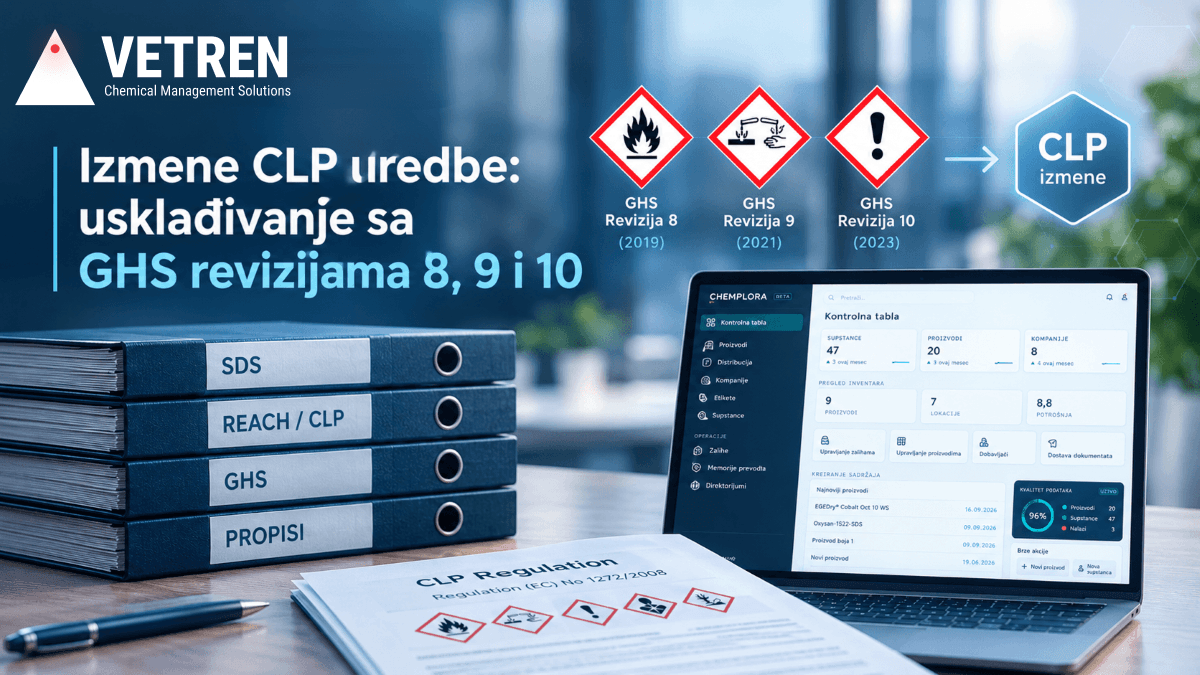
CLP amendments: alignment with GHS revisions 8, 9 and 10
04/10/2026 | By Ivan Milenković
The European Commission has prepared a draft that amends the CLP Regulation. The aim is alignment with revisions 8, 9 and 10 of the Globally Harmonized System (GHS). The draft takes the form of a Commission Delegated Regulation. It also partially takes over revision 11.
This is the first article in a series on the draft. Today we give an overview of its scope, the annexes being amended and the transition deadlines. The next articles cover hazard communication, physical hazards and health hazards in detail.
Why CLP is periodically aligned with the GHS
Regulation (EC) No 1272/2008, known as CLP, governs the classification, labelling and packaging of substances and mixtures in the EU. It takes over the criteria and hazard communication elements of the United Nations GHS, which serves as the umbrella document.
The GHS is revised every two years. Revisions bring in new scientific data, technical progress and experience from practice. As a result, classification criteria, hazard statements and precautionary statements change.
The EU has committed to implementing the GHS. That is why CLP is amended from time to time, so that it stays aligned with it. Revisions 8, 9 and 10 stem from amendments adopted in 2019, 2021 and 2023. The draft now takes them over in a single step.
The part of revision 11 taken over right away
Revision 11 was adopted on December 6, 2024. Most of its changes will be taken over later. Even so, the draft already takes over two parts of it.
The first part concerns aerosols. Revision 10 contained unclear criteria for their classification, which made them hard to apply. Revision 11 removed that ambiguity.
The second part concerns mixtures that cause skin sensitization. Revision 10 amended the criteria for substances. Revision 11 then finished the job by amending the criteria for mixtures.
The Commission gives a clear reason for this approach. It avoids amending the same provisions twice within a short period. It also gives suppliers and downstream users greater legal certainty.
Which CLP annexes are amended
The draft amends six annexes of the CLP Regulation. Besides aligning with the GHS, it also corrects inconsistencies and editorial errors identified in practice.
| CLP annex | Content | Type of change |
|---|---|---|
| Annex I | Classification and labelling criteria | amendments and corrections |
| Annex III | Hazard statements (H) | amendments |
| Annex IV | Precautionary statements (P) | amendments |
| Annex V | Hazard pictograms | amendments |
| Annex VI | Table 1.1, hazard class and category codes | amendments |
| Annex VIII | Information for emergency health response | corrections |
One practical note for reading the draft. The draft’s annexes have their own numbering. For example, Annex II of the draft amends Annex III of the CLP Regulation, and Annex III of the draft amends Annex IV. When citing sources, always check which CLP annex a change actually refers to.
Key changes by area
A new hazard class is introduced: chemicals under pressure. It covers liquids or solids pressurized with a gas in receptacles other than aerosol dispensers. The class has three categories and new hazard statements H282, H283 and H284.
Explosives get a new structure, with Category 1 and sub-categories 2A, 2B and 2C. Hazard statements H200 to H203 and H205 are deleted. H209, H210 and H211 are introduced in their place.
Precautionary statements undergo a thorough rationalization. The statements on medical assistance, P310 to P315, are deleted. They are replaced by P316, P317, P318 and P319. In addition, P201 and P202 are replaced by a single statement, P203.
For health hazards, a tiered approach to classification is introduced. It applies to skin corrosion and irritation, serious eye damage and eye irritation, and skin sensitization. In vitro and ex vivo methods also get a clearer place in classification.
We cover each of these areas in detail in the upcoming articles in the series.
Deadlines: 24 months to apply, 48 for existing stock
The deadlines are set out in Article 2 of the draft. The regulation enters into force on the twentieth day following its publication in the Official Journal of the EU. The publication date is not yet known.
The new rules become mandatory 24 months after entry into force. Suppliers may, however, apply them earlier on a voluntary basis.
A longer deadline applies to products already on the market. Substances and mixtures classified and labelled under the current rules may remain on the market without relabelling, provided they were placed on the market before the date of mandatory application. This transitional period runs until 48 months after entry into force.
Here is an example with a hypothetical date. If the regulation entered into force on July 1, 2027, the new rules would be mandatory from July 1, 2029. Products labelled under the old rules and placed on the market before that day could stay on the market until July 1, 2031.
It is also important to keep the status of the document in mind. This is a draft, so the final text may differ. Once adopted, the delegated act goes through a scrutiny period during which the European Parliament and the Council may raise objections.
Transition costs and the label cycle
In its explanatory memorandum, the Commission acknowledges that the changes will cause additional costs. They arise mostly where the safety data sheet and the label need to be revised.
Three mechanisms soften these costs: deferred application, the option of applying the rules early and a longer deadline for products already on the market. The Commission also refers to a study on the average label revision cycle. According to that study, labels are changed for marketing reasons on average every 18 months.
So most of the changes can be fitted into the regular cycle. That still takes planning, not a last-minute reaction.
CLP amendments and businesses in Serbia
The CLP amendments do not apply in Serbia directly. Serbian legislation takes over CLP through the GHS Rulebook, with a certain delay. For example, the latest amendment to that rulebook (Official Gazette of RS, No. 91/2025) is based on Delegated Regulation (EU) 2023/707.
Even so, Serbian businesses will feel the effects well before the rulebook is amended. The reason is simple: supply chains do not respect borders.
Importers will be the first to notice the change. During the voluntary application period, safety data sheets from EU suppliers will start arriving with the new statements. However, until the changes are transposed into Serbian legislation, the new statements are not part of the Serbian rulebook. When adapting such safety data sheets, you therefore need to check which version of the rules applies.
Exporters: agreeing with customers and packaging stock
Exporters to the EU apply the new rules directly, within the deadlines set in Article 2. But the deadline itself is not the only question. The voluntary application period also raises the question of when to switch.
Some customers will ask for the new statements as soon as the regulation enters into force. Others will want to wait for the date of mandatory application. It is therefore a good idea for exporters to agree with their customers in good time on when they will switch to the new P statements.
Stock also needs to be taken into account. Printed labels and packaging with the old statements are a cost that should be used up before the switch. Planning print orders therefore becomes part of the preparation.
Finally, there is the workload on safety data sheets. Replacing P statements affects a large share of existing documents. A wave of safety data sheet revisions over the next two to four years is a realistic expectation. Companies that maintain dozens or hundreds of documents should schedule that work in good time.
How to plan the transition
The first step is an inventory of the products affected by the replacement of P statements. That means every safety data sheet and label carrying P201, P202 and P310 to P315. Do not forget combinations such as P301 + P310 or P337 + P313.
Next, review your portfolio for physical hazards. Explosives, aerosols and products in pressurized receptacles deserve particular attention.
Then single out mixtures that contain skin sensitizers. Their classification should be checked again once the final text is published.
If you export, agree with your customers on when to switch to the new statements. Also take stock of printed labels and packaging.
Finally, align the changes with your own label printing cycle. That way you avoid paying twice and needlessly scrapping stock.
Frequently asked questions
When do the CLP amendments enter into force? The regulation enters into force on the twentieth day following its publication in the Official Journal of the EU. The new rules become mandatory 24 months later. The publication date is not yet known.
Which GHS revisions does the draft take over? The draft takes over GHS revisions 8, 9 and 10. From revision 11, it takes over only the provisions on aerosols and on mixtures that cause skin sensitization.
Do I have to change my labels right away? No. The new rules may be applied voluntarily, and they become mandatory 24 months after entry into force. Products placed on the market before that date may remain on the market until 48 months have passed.
Which P statements are deleted? P201, P202 and P310 to P315 are deleted. P203, P316, P317, P318 and P319 are introduced. Combinations that contain the deleted statements also change.
What are chemicals under pressure? They are liquids or solids pressurized with a gas at a pressure of at least 200 kPa at 20 °C. They are contained in pressurized receptacles other than aerosol dispensers. The class has three categories, with hazard statements H282, H283 and H284.
Do the CLP amendments apply in Serbia? Not directly. Serbian legislation takes over CLP through a rulebook, with a delay. Exporters to the EU, however, apply the new rules directly and should agree with their customers on when to switch.
References:
This blog post is for informational purposes only and does not constitute legal advice. For specific situations, consult a licensed chemical adviser or a lawyer specialising in chemical regulation.
← Back to blog